
January 8, 2024

When you feel tired or run down, it is easy to wonder whether your body needs more vitamins. You might consider taking an oral supplement, changing your diet, or booking an IV vitamin infusion. With so many wellness options available, knowing which approach makes sense for your health can be confusing.
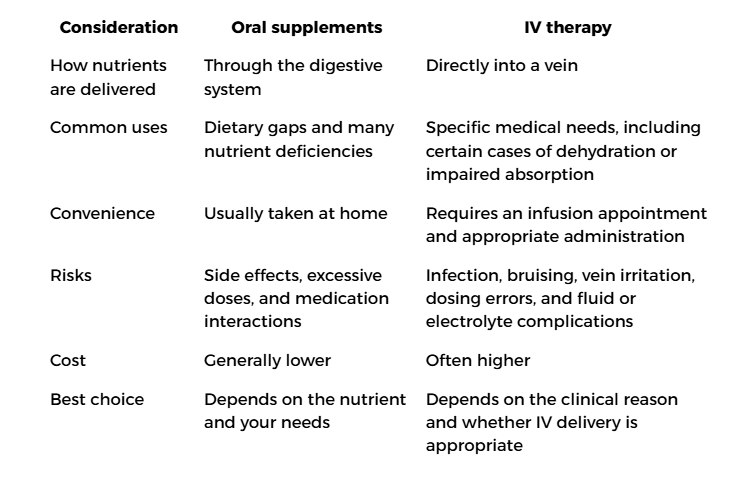
The answer depends on what your body needs, whether you have a diagnosed deficiency, and how well you absorb nutrients. IV therapy delivers fluids and nutrients directly into a vein, while oral supplements pass through your digestive system. Both have legitimate medical uses, but they are not interchangeable, and IV treatment is not automatically more effective simply because it enters the bloodstream directly.
If you're exploring IV therapy in Jacksonville, understanding the differences between these options can help you make a more informed decision.
Oral supplements come in forms such as tablets, capsules, powders, and liquids. After you swallow them, your digestive system processes the nutrients, which are then absorbed into the bloodstream. For many common nutritional needs, oral supplements are convenient, effective, and less invasive than an infusion.
IV therapy delivers fluids and selected nutrients directly into a vein through an intravenous line. Because the digestive system is bypassed, IV administration can be useful in specific medical situations, including certain cases of dehydration, nutrient deficiencies, or problems with absorption.
However, delivering a nutrient directly into the bloodstream does not automatically mean the treatment offers greater health benefits. The right option depends on the reason for treatment, the substance being administered, its dose, and your individual health needs.
For many people, oral supplements are a practical starting point when additional nutrients are needed.
If a healthcare provider identifies a deficiency, oral supplementation often provides an effective way to restore nutrient levels. For example, many cases of iron deficiency or vitamin B12 deficiency can be treated with oral supplements, although the best approach depends on the severity and cause.
Some people need a different treatment because of poor absorption, significant symptoms, or other medical considerations. That decision should be based on an appropriate assessment rather than a general wellness trend.
A balanced diet is the foundation of good nutrition. Supplements can fill specific gaps when dietary intake is inadequate or when a person's circumstances increase their nutritional requirements.
For example, a healthcare professional might recommend a supplement based on your diet, age, pregnancy status, medications, or laboratory results.
Oral supplements are usually easier to take at home, do not require an IV line, and generally cost less than an infusion. They also avoid risks associated with inserting a needle into a vein.
Taking more supplements than recommended is not necessarily beneficial. Some vitamins and minerals can cause harm in excessive amounts or interact with medications, so follow professional guidance and product instructions.
IV treatment has an established role in healthcare, particularly when fluids or nutrients need to be delivered intravenously for a specific medical reason.
For example, clinicians use IV fluids in certain cases of significant dehydration. IV administration of particular nutrients may also be appropriate when a deficiency is severe, absorption is impaired, or oral treatment is unsuitable.
Wellness IV services sometimes offer combinations of fluids, vitamins, and minerals. However, evidence supporting the benefits of these infusions in otherwise healthy people without a diagnosed deficiency is limited. Claims that they reliably boost immunity, cure fatigue, prevent illness, or improve energy in everyone should be treated cautiously.
Before choosing an infusion, ask what each ingredient is intended to do, why you need it, and what evidence supports its use for your specific concern.
Persistent fatigue can have many causes, including insufficient sleep, stress, anemia, thyroid problems, medication effects, infections, and nutritional deficiencies.
If you feel exhausted regularly, it is worth investigating the reason instead of assuming you need a vitamin infusion. A healthcare provider can review your symptoms and medical history and determine whether an examination or laboratory testing is appropriate.
If testing identifies a deficiency, treatment should address that finding. If your nutrient levels are normal, taking additional vitamins or receiving an infusion might not improve your energy.
At AIOH, we encourage patients to discuss ongoing symptoms before choosing a wellness treatment. Understanding the cause of a concern helps you make a more informed decision about your next step.
If you're comparing Jacksonville IV therapy providers, take time to understand the service, the ingredients used, and the qualifications of the healthcare professionals overseeing your treatment.
Before proceeding, ask these questions:
These considerations are useful whether you're looking for an IV service in Jacksonville or comparing options for IV therapy in Jacksonville Beach. Choose a provider who explains the treatment clearly and never pressures you into unnecessary sessions.
No. IV therapy is not appropriate for every person or every health concern. The risks depend on the ingredients, dose, infusion rate, and your medical history.
Potential complications include bruising, infection at the insertion site, vein inflammation, allergic reactions, and problems caused by excessive fluid or certain electrolyte levels. Some vitamins can also be harmful in high doses, particularly for people with specific medical conditions.
Tell your healthcare provider about your medications, allergies, kidney or heart conditions, pregnancy, and any supplements you already take. Do not use IV wellness treatments as a substitute for urgent medical care or an assessment of unexplained symptoms.
IV administration delivers substances directly into the bloodstream, but faster delivery does not guarantee a better outcome. Whether IV treatment provides a meaningful advantage depends on the nutrient, the medical reason for treatment, and your individual circumstances.
Some wellness services offer infusions to people without a diagnosed deficiency, but evidence that these treatments improve general wellness in otherwise healthy individuals is limited. Discuss the expected benefits, risks, and alternatives with a qualified healthcare professional.
There is no universal schedule that suits everyone. Frequency should depend on the reason for treatment, the ingredients being administered, your health status, and the advice of your healthcare provider. Repeated infusions should have a clear clinical rationale.
Oral supplements are sufficient for many nutritional needs, while IV therapy has an important role in specific medical situations. The goal is not to choose the most intensive treatment. It is to choose the option that makes sense for your health.
At AIOH, we offer IV drips and injections as part of our healthcare services. If you're considering an infusion, call (904) 371-7744 to discuss your questions and find out whether an assessment is appropriate. We'll help you understand your options and the considerations involved before you make a decision.
This article is for general educational purposes and does not replace individualized medical advice. IV therapy should be assessed and administered by qualified healthcare professionals.