
January 8, 2024
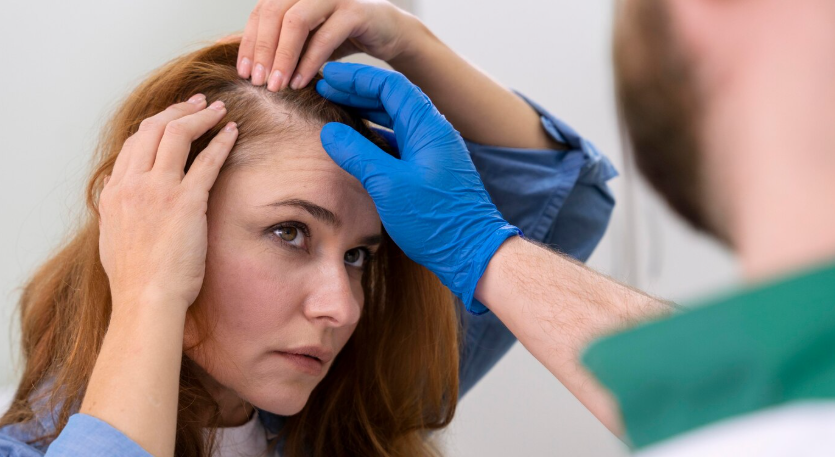
Hair loss can be confusing because the cause isn't always where you expect it to be.
You might notice more strands on your pillow, a brush that suddenly seems much fuller, or a shower drain that looks like it has collected far more hair than usual. Maybe you've also noticed a bald patch or that your part looks wider than it did a few months ago.
And then comes the inevitable question: Why is this happening now?
Sudden hair shedding can have many causes, and not all of them mean permanent hair loss. In some cases, the hair-growth cycle has simply been disrupted by something that happened weeks or months earlier. In others, sudden changes can point to an underlying medical or scalp condition that deserves attention. The American Academy of Dermatology notes that identifying the cause is one of the most important steps in determining whether hair can regrow on its own or needs treatment.
At All In One Healthcare (AIOH) in Jacksonville, hair concerns can be evaluated as part of a broader approach to your health. The goal isn't to immediately assume you need a particular treatment. It's to understand what changed and why.
Some hair shedding is completely normal. The American Academy of Dermatology notes that losing around 50 to 100 hairs a day can be part of the normal hair-growth cycle.
What gets your attention is a noticeable change.
You may suddenly find significantly more hair in your brush or shower, notice thinning across the scalp, see a bald patch, or realize that your ponytail has lost some of its fullness.
The pattern matters.
Gradual thinning can have different causes from hair that begins falling out in larger amounts over a short period. A bald patch may point to something different again.
That is why sudden shedding is worth investigating instead of automatically assuming it's genetic hair loss.
One of the strangest things about stress-related hair shedding is the timing.
You could go through a stressful period, recover, and then notice increased shedding months later.
A significant illness, surgery, childbirth, or major emotional stress can trigger a temporary type of shedding called telogen effluvium. The AAD notes that excessive shedding may occur a few months after the stressful event.
This delayed reaction can make the connection difficult to spot.
You might think, "I'm not even stressed anymore," while your hair is still responding to what happened earlier.
The encouraging part is that when the trigger is temporary and resolved, hair may gradually return to its previous fullness.
Your hair can respond to major physical stress too.
A high fever, significant infection, surgery, or other illness can temporarily disrupt the hair-growth cycle. Some people notice substantial shedding several months after recovering rather than during the illness itself.
So if your hair suddenly started shedding after a period when you were sick, make sure your healthcare provider knows about it.
That timeline could be an important clue.
For many new mothers, increased hair shedding can be surprising.
During pregnancy, hormonal changes can keep more hairs in the growth phase. After delivery, changing hormone levels can cause more hairs to enter the resting and shedding phase.
The AAD notes that postpartum shedding commonly becomes noticeable a few months after childbirth and is usually temporary, with many women regaining normal fullness within the first year.
If shedding continues longer than expected or your hair doesn't begin returning to normal fullness, it's worth getting evaluated rather than assuming everything is still postpartum.
Your thyroid influences many processes throughout the body, and thyroid disease can also affect your hair.
The AAD lists thyroid disease as one possible cause of thinning hair or increased shedding.
This doesn't mean sudden hair loss automatically means you have a thyroid problem. It simply means that if hair changes occur alongside other changes in your health, your primary care provider may consider whether thyroid evaluation is appropriate.
This is one reason having a regular primary care physician in Jacksonville can be useful. Your hair concern may be the symptom that prompts a conversation about your broader health.
Hair follicles need adequate nutrition to support normal growth.
Inadequate amounts of certain nutrients including iron, protein, zinc, and biotin can contribute to noticeable hair loss.
This can become particularly relevant if you've recently changed your diet, significantly restricted calories, or experienced rapid weight loss.
But here's where it gets important: don't assume you need a cabinet full of hair supplements.
More isn't always better. The AAD notes that taking excessive amounts of certain nutrients can actually contribute to hair loss.
If you're concerned about a deficiency, a healthcare provider can determine whether further evaluation makes sense.
Certain medications list hair loss as a possible side effect.
If your shedding began after starting a new medication or after changing the dose of an existing one tell the healthcare professional who prescribed it.
Don't stop a medication on your own simply because you suspect it's affecting your hair. Your provider can help determine whether the medication could be contributing and what options are appropriate.
Sometimes the cause isn't internal at all.
Repeated chemical treatments, excessive heat, or hairstyles that constantly pull on the scalp can contribute to hair damage and, in some cases, hair loss. Tight hairstyles can cause traction alopecia, and repeated damage to hair follicles can lead to permanent loss.
If your recent hair routine has changed, consider whether your scalp and hair are being exposed to more tension or chemical processing than usual.
Not every increase in shedding requires immediate medical attention.
But it's worth scheduling an evaluation if the change is significant, persistent, unexplained, or accompanied by other symptoms.
You should especially pay attention to rapidly developing bald patches, scalp inflammation or scaling, significant thinning, or hair loss that continues without improvement.
The AAD recommends seeking evaluation because hair loss has many possible causes, and treatment tends to be more effective when the cause is identified early.
At All In One Healthcare, hair concerns are approached as part of your overall health rather than simply a cosmetic issue.
AIOH is located on Beach Blvd in Jacksonville and provides primary care alongside services including hair restoration, medical weight loss, aesthetics, and IV drip and injection services. The practice is led by Dr. Mohammed Touheed, MD, who takes a personalized approach to patient care.
For someone experiencing sudden shedding, that broader healthcare setting can be useful because the first question isn't necessarily, "Which hair treatment should I get?"
It may be:
"What changed?"
Once potential causes have been considered, your provider can determine whether additional testing, primary care evaluation, or hair restoration services may be appropriate.
AIOH also offers a non-invasive Hair Wellness System as part of its hair restoration services, giving patients an option to discuss physician-guided hair care without jumping straight into invasive procedures.
Seeing more hair than usual can be scary, but sudden shedding doesn't automatically mean permanent hair loss.
Sometimes your hair is responding to stress, illness, childbirth, nutrition, medication, or another temporary change. Other times, it may be an early sign of a condition that deserves medical attention.
The important thing is to find out which situation you're dealing with.
If you've noticed a sudden change in your hair, book an appointment at All In One Healthcare on Beach Blvd to discuss your concerns and determine whether a medical evaluation or personalized hair restoration plan may be right for you.
Your hair may be the first thing you notice but understanding the reason behind the change is what really matters.
The American Academy of Dermatology notes that losing around 50 to 100 hairs each day can be normal. A noticeable increase beyond your usual shedding pattern may warrant evaluation.
Yes. Significant physical or emotional stress can trigger temporary excessive shedding, sometimes several months after the stressful event.
It depends on the cause. Some forms of temporary shedding can resolve once the underlying trigger is addressed, while other types of hair loss may require treatment.
Don't assume supplements are the answer. Nutritional deficiencies can contribute to hair loss, but taking excessive amounts of certain nutrients may also be harmful. Discuss supplementation with a healthcare provider.
Yes. AIOH offers non-invasive hair restoration services and can also provide primary care evaluation when broader health concerns may be relevant.